
Last reviewed: October 23, 2026. Sources: Kroger’s “Protect Yourself from Fraud” page, the live Kroger survey form, and the Federal Trade Commission’s consumer guidance.
The real Kroger survey starts from your receipt, not from a text message. You type kroger.com/feedback yourself, enter details printed on your receipt, and the reward is a 50-point bonus, not cash or a gift card.
So a text that says “You’ve been selected for a Kroger survey, claim your $100 gift card” is almost certainly a scam. The same goes for messages asking for card numbers, passwords or a “shipping fee” to collect a prize.
This guide shows what the real survey looks like, the warning signs of a fake one, and what to do if you already clicked.
How does the real Kroger survey work?
Knowing the real process makes fakes easy to spot. Here’s what the genuine survey involves, as of October 2026.
| Real Kroger survey | Typical fake |
|---|---|
| Invitation printed at the bottom of your receipt | Arrives by text, email or social media ad |
| You type kroger.com/feedback yourself | You tap a link someone sent you |
| Asks for receipt details: Entry ID or store phone number, date and time of visit | Asks for name, address, card number, password or bank details |
| Reward is a 50-point bonus, limited to one per 7 days | Promises cash, a large gift card or a prize |
| Free to take | Asks for a small “shipping” or “processing” fee |
| Form runs on Qualtrics, with “Powered by Qualtrics” and a Kroger Privacy Policy link | Odd domain, misspellings, countdown timers |
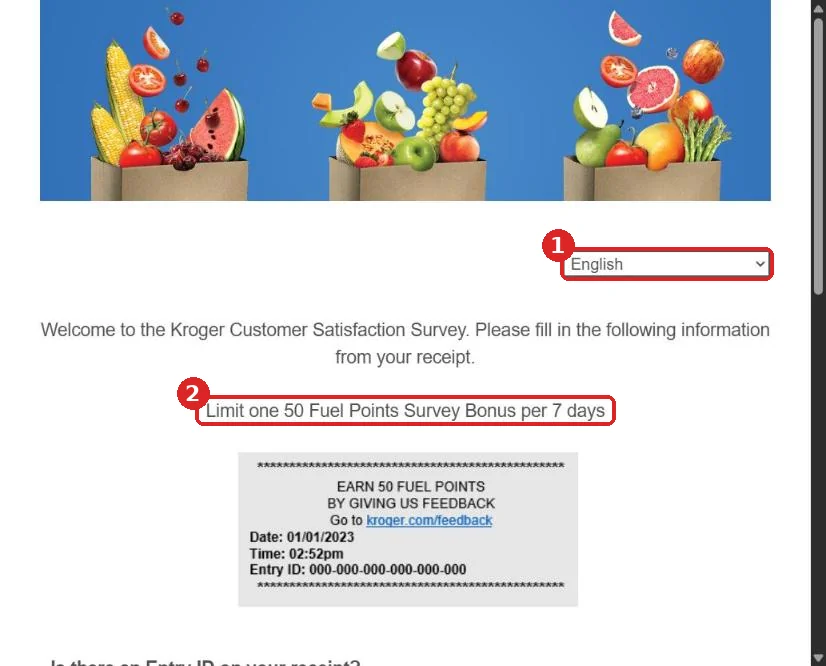
After you open kroger.com/feedback, the address bar changes to a link starting with 8451cx.az1.qualtrics.com. That’s normal. Qualtrics is the survey company that hosts Kroger’s form.
The old address, krogerfeedback.com, didn’t load at all when we tested it in October 2026. If a site using that name asks for personal details, close it.
Our Kroger feedback survey guide shows every screen of the genuine survey, so you can compare.
What do Kroger survey scam texts look like?
Scam texts change wording all the time, but they follow a few patterns. The examples below are made up to show the style; they aren’t real messages.
- “Kroger: You’ve been chosen for our customer survey. Complete it to claim your $100 reward card: [link]”
- “Congrats! Your Kroger loyalty points are about to expire. Redeem now for a free gift: [link]”
- “Kroger order #4821 could not be delivered. Confirm your address here: [link]”
- “Your Kroger account has been locked due to suspicious activity. Verify your card: [link]”
Each one pushes you to tap a link fast. The prize, the expiring points, the failed delivery and the locked account are all there to make you act before you think.
These match the scam types the Federal Trade Commission sees most. In an April 2025 release, the FTC said fake package delivery texts were the most commonly reported text scam, followed by job scams, fake fraud alerts, unpaid toll texts and “wrong number” messages.
The money involved is large. The FTC said consumers reported losing $470 million in 2024 to scams that started with a text, five times the amount reported in 2020.
Seven warning signs of a fake Kroger survey
You don’t need to be an expert to spot most fakes. Check for these signs.
1. You didn’t start it
The real survey invitation is on your receipt. If a survey reached you by text, email or social media without you shopping recently, treat it as suspicious.
2. The prize is too big
The genuine reward is 50 points, half of the 100 points needed for 10¢ off per gallon. It’s nowhere near a $100 or $500 gift card. The FTC notes that scam texts often promise “free prizes, gift cards, or coupons.”
The current survey page doesn’t mention any sweepstakes or cash prize at all. Older claims about large cash drawings still circulate online, but the form we checked only mentions the points bonus.
3. It asks for financial details
The real survey asks for an Entry ID or store phone number, plus your visit date and time. It doesn’t ask for card numbers, bank details or your Social Security number.
The FTC says it plainly: “Legitimate companies won’t ask for information about your account by text.”
4. It asks you to pay
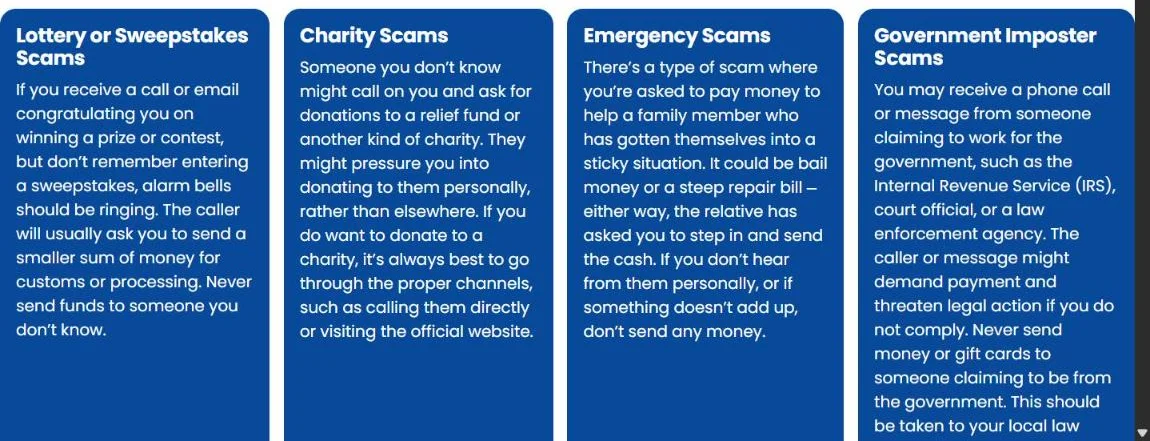
Any “shipping fee,” “processing fee” or “customs charge” to collect a reward is a red flag. Kroger’s fraud page warns that lottery and sweepstakes scammers usually ask for “a smaller sum of money for customs or processing.”
5. It wants gift cards as payment
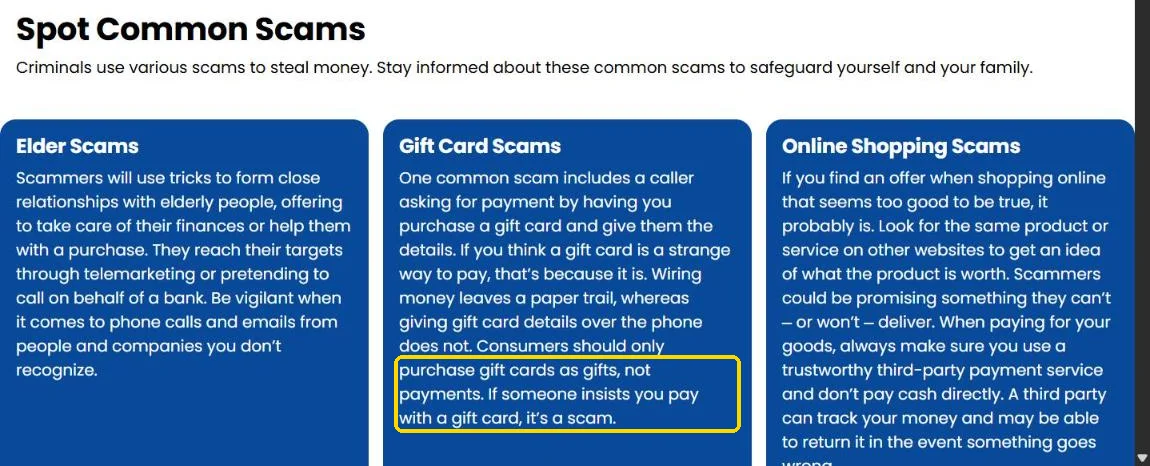
Kroger is direct about this. Its fraud page says “consumers should only purchase gift cards as gifts, not payments. If someone insists you pay with a gift card, it’s a scam.”
6. The link looks off
Look for a misspelled store name, extra words added to it, or an unusual ending to the web address. The FTC warns that scam links can lead to “a spoofed website that looks real but isn’t.”
Don’t tap to check. Long-press or copy the link text instead, or simply type kroger.com yourself.
7. It rushes you
Countdown timers, “only 3 rewards left,” or “expires in 24 hours” are pressure tactics. The real survey has a 7-day window from your shopping trip, but nobody counts down at you.
Other scams that use the Kroger name
Survey bait isn’t the only trick. Scammers borrow any brand people trust, and a big grocery chain is an easy target. Watch for these variations too.
| Fake message | Why it’s suspicious | What to do instead |
|---|---|---|
| “Your Kroger Delivery couldn’t be completed, update your address” | Fake delivery texts are the FTC’s most reported text scam | Check the order in the Kroger app |
| “Your Kroger points expire today, claim a gift” | Points expire on a monthly schedule, and points don’t turn into gifts | Check your balance on Kroger.com or the app |
| “Your Boost membership renewed for $299, call to cancel” | Boost costs $69 to $99 a year, and renewals are managed online | Check Membership Management on Kroger.com |
| “Kroger is hiring, pay a fee for your training kit” | The FTC lists job scams among the top text scams | Apply only through Kroger’s official careers site |
| “Your Kroger account is locked” | Pushes you to a fake sign-in page | Type kroger.com yourself and sign in there |
The pattern is the same each time. Someone contacts you first, creates urgency, and asks you to act through their link or phone number instead of Kroger’s.
Helping older relatives stay safe
Kroger’s fraud page lists elder scams first. It says scammers “reach their targets through telemarketing or pretending to call on behalf of a bank.”
A short conversation can prevent a big loss. Agree on a simple family rule: nobody pays for anything by gift card, and any message about money gets checked with a family member first.
Show them where the real survey invitation is on their receipt. Once they know the genuine version, the fakes stand out.
Turning on spam filtering on their phone helps too. Most phones have an option to filter messages from unknown senders into a separate folder.
What does Kroger say about scams?
Kroger runs a “Protect Yourself from Fraud” page on Kroger.com, under its Money Services section. It lists the scams Kroger customers report most.
| Scam type | What Kroger says |
|---|---|
| Gift card scams | Buy gift cards as gifts, not payments |
| Lottery or sweepstakes | Be wary of a prize you don’t remember entering, especially if you’re asked to pay a fee |
| Government imposters | Never send money or gift cards to someone claiming to be from the government |
| Emergency scams | If a relative asks for money and you can’t reach them directly, don’t send any |
| Elder scams | Be careful with calls and emails from people and companies you don’t recognize |
| Online shopping scams | If an offer seems too good to be true, it probably is |
The page also gives a “never” list. Kroger says never make a money transfer or buy gift cards to claim prize winnings, pay government taxes or fines, donate to unregistered charities, resolve immigration matters, or pay for something you already bought online.
For its own money services, Kroger says it “will always ask for ID whenever someone sends or collects money.” Someone asking you to send money without that step isn’t following Kroger’s process.
What should you do if you get a suspicious text?
Don’t reply, and don’t tap the link. Even replying “STOP” tells the sender your number is active.
The FTC lists three ways to report it:
- Forward the text to 7726 (which spells SPAM). This alerts your wireless carrier.
- Use your messaging app’s “report junk” or “report spam” option.
- Report it to the FTC at ReportFraud.ftc.gov.
Then delete the message. If you want to check whether Kroger really contacted you, call 1-800-KRO-GERS (1-800-576-4377) or sign in at Kroger.com yourself.
The FTC’s rule of thumb fits here: if a message might be real, “contact the company using a phone number or website you know is real.” Our Kroger customer service guide lists Kroger’s official contacts.
Cutting down on scam texts
The FTC suggests turning on your phone’s option to filter messages from unknown senders. Your wireless provider may also offer blocking tools, and some call-blocking apps block texts too.
This won’t stop every scam. It does keep the most obvious ones out of your main inbox, which helps older family members in particular.
What if you already clicked or shared information?
Act quickly, and don’t feel embarrassed. These messages are built to fool careful people.
| What happened | What to do |
|---|---|
| You tapped the link but entered nothing | Close the page. Update your phone’s software and run a security scan if you have one. |
| You entered your Kroger password | Change your Kroger password right away, and change it anywhere else you use the same one. |
| You entered a card or bank number | Call your bank or card issuer using the number on the back of your card. |
| You gave your Social Security number | Go to IdentityTheft.gov for step-by-step recovery actions. |
| You paid with a gift card | Contact the gift card company immediately and keep the card and receipt. |
| Your Kroger points disappeared | Call Kroger at 1-800-576-4377. |
The FTC’s phishing guidance says that if you clicked a link or opened an attachment, update your security software and run a scan. If you gave out a Social Security, credit card or bank number, it points you to IdentityTheft.gov.
Report the scam even after the fact. Kroger’s fraud page says you can contact the Federal Trade Commission to file a report online.
Protecting your Kroger account
Your Kroger digital account holds your points, purchase history and sometimes pharmacy details. A few habits keep it safer.
- Use a password you don’t use anywhere else. Kroger’s FAQ says it’s your responsibility to “select a strong password, change it regularly, not reuse or share your password.”
- Never share a verification code sent to your email or phone, even with someone claiming to be from Kroger.
- Check your points balance now and then. A sudden drop you can’t explain is worth a call.
- Sign in by typing kroger.com or using the official Kroger app, not through links in messages.
If you’re setting up an account for the first time, our Kroger Rewards sign-up guide walks through it safely.
Fake receipt and refund offers
Some websites offer to create fake store receipts. Using a fake receipt for a refund or a survey is fraud, and the survey form says it uses receipt details to link your visit to a specific store.
Be equally wary of unexpected “refund” messages. Kroger’s real refund options are Purchase History, live chat, 1-800-KROGERS and the store’s customer service desk. Our Kroger receipts and refunds guide explains each one.
Common questions about Kroger survey scams
Does Kroger text you survey links?
The genuine survey invitation we’ve seen is printed on the receipt and points to kroger.com/feedback. If a text sends you a survey link, don’t tap it; type kroger.com/feedback yourself if you have a receipt.
Is the Kroger $100 gift card survey real?
The real Kroger survey offers a 50-point bonus. A message promising a large gift card for a few questions shows the signs of a scam.
Is kroger.com/feedback safe?
Yes. It’s the address printed on Kroger receipts, and it opens Kroger’s official survey form hosted by Qualtrics.
Where do I report a Kroger scam text?
Forward it to 7726 (SPAM), report it in your messaging app, and file a report at ReportFraud.ftc.gov.
Will Kroger ask me to pay with gift cards?
Treat any such request as a scam. Kroger’s fraud page says that if someone insists you pay with a gift card, it’s a scam.
What if a scammer used my Kroger points?
Change your password and call Kroger Customer Service at 1-800-576-4377 to report it.
KrogerFeedbacks.us is an independent guide and is not affiliated with The Kroger Co. We will never text you, ask for your Kroger password, or ask for payment details.